- Introduction
- A short history of scientific misconduct, the case of the Netherlands
- From Fishy to fraud – a discussion about the grey area
- PhD candidates: a special case?
- Closing remarks
Hope to see you there!
Hope to see you there!
 At the department of Clinical Epidemiology of the LUMC we have a continuous course/journal in which we read epi-literature and books in a nice little group. The group, called Capita Selecta, has a nice website which can be found here. sometime ago we’ve read an article that proposed to include dormant Mendelian Randomisation studies in RCT, to figure out the causal pathways of a treatment for chronic diseases. This could be most helpful when there is a discrepancy between the expected effect and the observed effect. During the discussion of this article we did not agree with the authors for several reasons. We, AGCB/IP/myself, decided to write a LTTE with these points. The journal was nice enough to publish our concerns, together with a response by the authors of the original article. The PDF can be found via the links below which will take you to the website of the American Journal of Epidemiology. The PDF of our LTTE can also be found at my mendeley profile.
original article
letter to the editor
response by the author
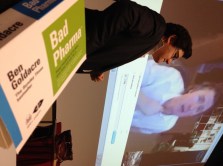
300 students reading one book, summarising it contents and discussing three propositions in order to grasp the essence of the book. This might sound a bit boring perhaps…But what if it Goldacres book Bad Pharma, you only have to read 30 pages and still get the content of the complete book, and get to Skype with the author? Great fun!
And we weren’t the only who had fun: Ben Goldacre addressed 300 students, all with critical questions, and apparently he enjoyed the whole debate:
We also invited AV, a spokesperson of NEFARMA an organisation who represents most pharmaceutical companies in the Netherlands. With him we discussed whether the AllTrials campaign was a waste of time and money. Also, BB a reporter from the Mare, who has knowledge on conflict of interest of professors joined in on the discussion whether professors should declare their COI before each lecture. All in all, it was a great day in which some of the students were shocked by the message of Ben Goldacre, whereas other students were not impressed and doubted whether there view is too one-sided… The debate still continues!
 This week, the Mare decided to run a story on Bad Pharma book by Ben Goldacre and our related symposium. The author, BB did an outstanding job in describing the argument Goldacre brings forward in his book. As you might know, we are organising a symposium for our 300 students that are following our course “academic and scientific training”, because I believe that doctors should learn about their field that they will graduate in once they have graduated. A quote from me in the Mare (in Dutch)
Dokter zijn gaat verder dan alleen het behandelen van één patiënt. Onze beroepsgroep heeft een bijzondere positie in de samenleving; mensen leggen letterlijk hun leven in je handen. Naast je arts-patiëntrelatie heb je ook te maken met de wetenschap, beleidsmakers en de farmaceutische industrie. Aankomende artsen moeten daarvan bewust worden en goed op de hoogte zijn van de ontwikkelingen in hun veld. Dit boek sloeg de spijker op zijn kop.
one little error slipped in… I am not a doctor and therefore it is officially not ‘onze beroepsgroep’ but i think people will grasp the point that I try to make. The complete article can be read here.
After 7 months of preparation the new and improved version of the second year course ‘Academic and Scientific Training’ is about to start. Tomorrow, 300 students will come together for two weeks to learn the how and why of clinical epidemiology. We emphasize on testing new treatments in RCT, and how doctors should critically appraise the articles that describe these studies.
Together with AvHV, JS and others we were able to secure funding to buy 400 copies of the book “Bad Pharma” (click for more background) In order to organise a ‘Bad Pharma Symposium’. In this symposium, all students will read the whole book, do some research on three topics which will be debated in the final debate. This will take a lot of commitment of all students, but what to think of the 40+ Teaching Assistants that we need for this course!
All in all, it’s time to start!
We started last week with a small group of 12 PhD candidates from all over the university. This pilot included candidates from law, physics, psychology, medicine and the campus The Hague were all present. Also present were TdC as a co-organiser and KS as our guest.
Although the formal evaluation forms have not been processed I guess we can establish that the pilot was succesful and with that I mean that the pilot showed that we are on the right track: of course some of the content needs to be changed, but the general flow of the workshop was great. The same goes for the participants and the location.
Below a short programme
The guys from the human resource department who are responsible for the general eduction programme of all PhD who start at the Leiden University have decided that this workshop is a great way to get this topic to the attention of young researchers. The first thought is to take this workshop as a compulsory part of the eduction programme. To cater to all the 400 new PhD students the university has, we need more scientist from all over the university who can teach this course. This means we need to work on the reproducibillity of the course. with more generic examples and a clear descrition of the reason why some parts are included etc. But if we succeed, I believe that this workshop is a great way to let PhD candidates talk and think about this subject matter, which hopefully will be of help in their scientific career.
PhD comics is the best way procrastinate during research. Today, they came up with a great video that examined the presumed link between vaccines and autism. Have a look!
The articles that need to be read for the journalclub meeting #7 and #8 are switched! See below for an update.
| 7 | 5-nov | Ovaska MT, Madanat R, Huotari K, et al. Risk Factors for Deep Surgical Site Infection. 2013;348–353. |
| 8 | 12-nov | Hernán M a., Hernández-Díaz S, Robins JM. A Structural Approach to Selection Bias. Epidemiology. 2004;15(5):615–625. |
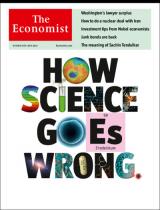
Fraud, shoddy and sloppy science, conflicts of interest… Who said a science career is boring? When I write on these topics I sometimes have the feeling that I am doing science more harm than good; am I doing science a favor by showing its weaknesses and caveats? The answer still remains yes, for I believe that we need problems need to be identified before you can act on them. This is also the theme of this post: What is all being done on these topics in the last couple of days. A point by point list:

The oral contraceptive pill ‘Diane 35- was’ in the news again. I wrote about the diane-35 pill on this website before, even twice, when there was a broadcast of the radio show Argos.
The first time I wrote:
[…] this is a bit strange: there is nothing new about the information that third and fourth generation oral contraceptives have an increased risk of thrombosis compared to the risk conveyed by second generation oral contraceptives. Because the desired effects of the older and newer generation pills are similar (not getting pregnant, preventing or curing acne) there is limited, if any, reason to prescribe the newest and more expensive pills. See also the recent comment by Helmerhorst and Rosendaal in the BMJ. However, still 160.000+ (Diane 35) 500.000 (third generation) women take these newer pills. […]
Those words also fit the broadcast of the TV show Zembla last week. Zembla has a reputation to be ‘activist reporters’ and some of the broadcast is not to my taste. It is however good to see that Zembla tried to figure out how it is possible that Diane-35, which is not registered as an anti-conception pill, still gets prescribed as such. However, the broadcast leaves me unsatisfied for it does not provide answers, or even get to talk to everybody they wanted to? (Why did they reporters did not proceed to work on their WOB? a missed change!)
As in the previous two blog posts on this topic, I feel like these story are important but they also need to have the proper amount of nuance. Therefore, also this time I conclude with saying that the absolute risk of thrombosis in young women (both venous and arterial) is very low, even when using oral contraceptives. But all unnecessary risk without any benefit that can be avoided should be avoided. As always, consult your GP if you have any questions.

On the 14th of september (a saturday) the Nacht van Kunst en Kennis will be organised in Leiden. During this festival, the differences and similarities between arts and science will be explored on several locations. A great initiative, which might just increase the public awareness of the necessity of interest free research.The program is quite interesting with inspiring scientist and great artists!
I will also be helping out during this festival night: I will host the section that is organised by science cafe leiden. This organisation tries to bridge the presumed gap between science and the lay person. We will be discussing several themes which are still subject to change… currently we are thinking along the lines of bounderies… Where is the line between just the right amount and to much. More information on this special section can be found here
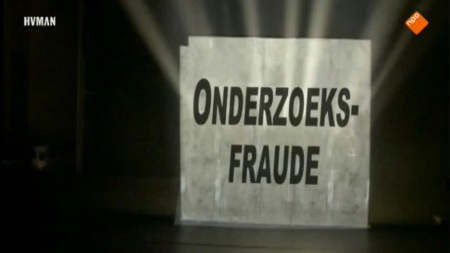
I find the several Dutch examples of scientific fraud and misconduct quite intriguing and I consider this topic to be one of my ‘projects’. I believe that these examples from the past learn us how the exactly the scientific community works. Different books, documentaries and reports have been published on this topic (such as the books from Frank van Kolfschoten, the weird apology-in-book-format from Diederik Stapel, the nice documentary on Buck, and the comprehensive reports from the KNAW such as the Schuyt report), and since last friday we can add an episode of the Dutch program “de vloer op” a TV program in which Dutch top actors improvise scenes which are only described in one little sentence.
For this scene, two actors are placed in an empty university dining hall, and the junior scientist is about to confront the senior prof with his suspicion of scientific fraud. The result can be seen here (unfortunately the video cannot be embedded on this wordpress.com website)
PS if you like “de vloer op” please consider to support this great program because the government support for HUMAN is not guaranteed. please visit their special website.
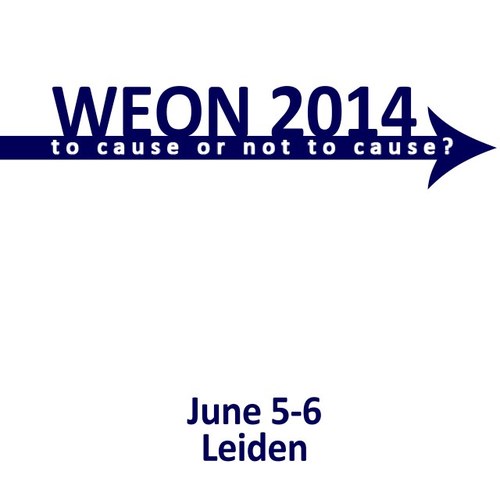
The WEON is the annual meeting of the VVE, the Dutch Epidemiological Society. The whole conference is held in English though, given that each more and more non Dutch also attend. These might be working here in the Netherlands, but we also have visitors from abroad. Last year, the WEON was organised in Utrecht with a couple of organisation from Utrecht and surroundings. The conference was a great succes with great preconferecence workshops and great plenary speakers, as I wrote before on the causality blog.
But now onto next year, when the WEON will be held in Leiden! Before you start with anything, you need to start with a motto and logo. Since the focusgroup “causality” is also based in Leiden the motto and the logo are off course linked to causal inference! Currently, we are working hard on the basic program. And specifically, I’m working on a special preconference workshop that is targeted at young epidemiologist. I got some ideas, but if you have any suggestions, please join the conversation via @WEON2014!
 I just got word that we got funding from an external to buy 400 copies of Bad Pharma to use as instruction material in our redesigned course on academic and scientific education. The book touches upon the role of the pharmaceutical industry in the design, execution, presentation and dissemination of results of clinical trials. The author, Ben Goldacre, identifies several problems and brings forth several solutions. But are these all correct?
We will use this basic question as the basis for a complete symposium on this topic: are the problems identified by Goldacre the real problems, or just cherry picked examples from the past? And are the solutions that he provides real solution that could work? And can we think of any other way to improve the care of our patients in the future?
I had this idea a long time ago when i first read this book. It touches upon a matter that is discussed in the old version of this course for a couple of years. Even more so: during this course students are asked to grade the quality of trials and the subsequent reference to this publication. The results show that the quality is often low, even in high impact journals, and that the references do not always justify the claims made in medical advertisements. These results have been published in several publications and are even cited in the book.
It was quite a hassle to get a ‘normal’ book into the curriculum of our medical center. Most people liked the idea of reading a book and organising a symposium, but a lot of people told me that it was impossible to do so. A “normal” book could not be placed on the mandatory reading list, and just buying electronic or hard copy versions is just way to expensive. luckily, with help from the Walaeus Library of the LUMC and prof FMH we were able to obtain external funding. And no, its not funded by ‘big pharma’, but a small fund that subsidises small but nice projects that make the world a bit smarter.
Today I participated in crowdsourced science: Measuring aerosols with my smartphone. Thousands of measurements in one day, all about the air quality in the Netherlands. The nice thing about this project is that laypeople are the researchers: everybody that ordered a free gadget for their iPhone is a researcher on this great sunny day. How the measurements work? See for yourself!
More on this project can be seen on their website ispex.nl. This project was made possible with funds fron the Dutch lung foundation and the Academische Jaarprijs. So is it time to think of a big epi project in which crowd sourced data can be used?
Today, I write from the Eurostroke conference. This conference is a yearly conference for stroke physicians and researchers to share knowledge, both existing and new. I always liked the idea of combining research and education in a conference.
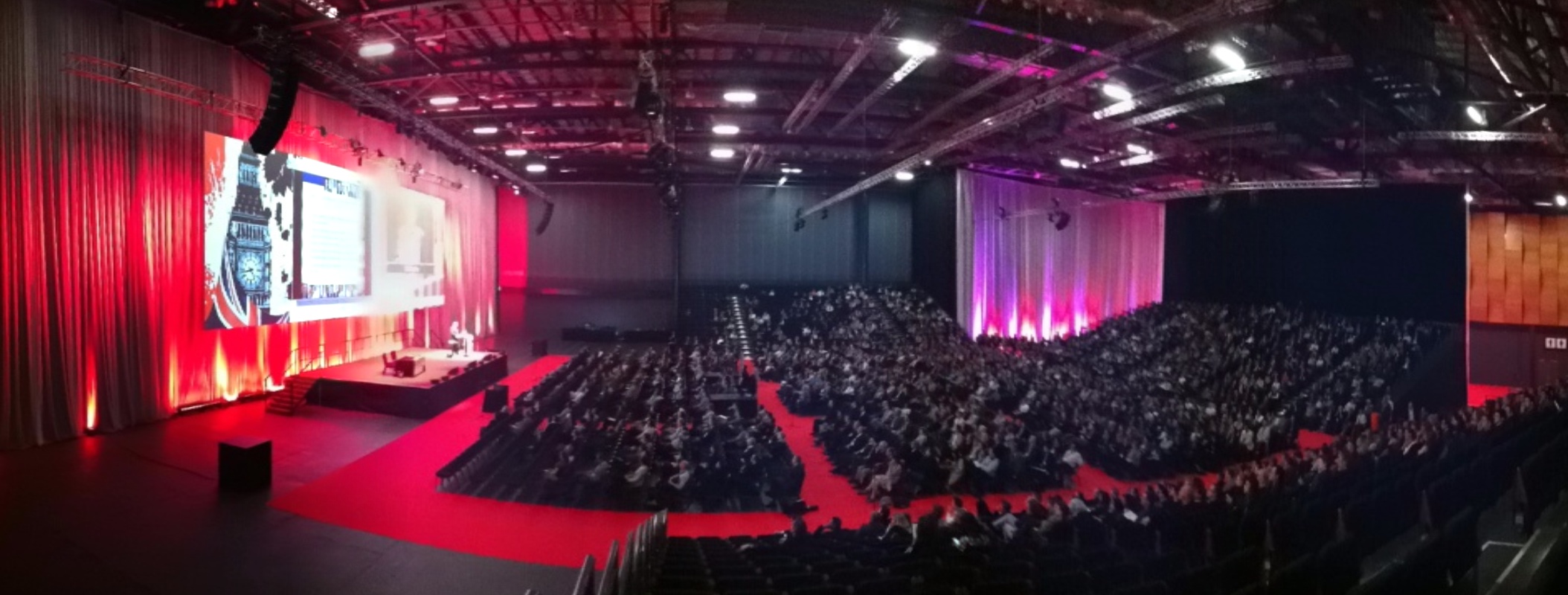
There are about 3500 delegates, as can be seen from the panorama photo I just took during the plenary clinical trials session. Although most of these topics are not directly of interest fr my own research, I enjoyed seeing how these PI share their work, which sometimes is a real impressive feat.
 I gotta run to my poster session, where I will present the poster below. If I referred you to this site to download the electronic version of the poster, you can click the link below.
Today, the course scientific education started. This course, a regular 2nd year course in the LUMC curriculum, runs for three weeks and is organised by AvHV and myself. This is the last year this course will be given in this form, and we are working hard to modify the course to make it fit in the new curriculum. This means that this year we have a opportunity to test some of my our ideas. One of these things is a non compulsory journalclub, in which we’re going to read one article with all students at the same time. I’m curious how may students really would like to train their scientific skills, outside of the curriculum.
Also, we are preparing a new full day interactive assignment and sympium, which is centered around the book Bad Pharma of author Ben Goldacre. I hope to fine some students that are wiling to help me in this development of this part of the new course. Exciting stuff!
– edit 30/5 : the course just finished and 320 students took their exam friday 24th. Although i do like students, I hope I won’t have to see them again for that will mean that they failed the course.

Today I got a letter from the Leiden University Fund (LUF) to inform me that the grant we requested was granted. This is great, because now we can investigate the long-term effects of young stroke, myocardial infarction and peripheral arterial disease. We will do this by linking our data from the RATIO to the several national databases (e.g. cause of death registries and hospital admissions) that are under control by the central bureau of statistics (CBS). I will perform this research together with AM and other Italian colleagues from Milan.
The grant (11K) that was awarded is the Den Dulk Moermans Fonds, which exist since 2010, as we can read from the Dutch information the LUF website:
Het Den Dulk-Moermans Fonds is opgericht in 2010 na ontvangst van een erfenis van dhr. A.M. den Dulk. De doelstelling van het Fonds is het financieren van onderzoek naar gezondheid in de breedste zin van het woord.

Together with colleagues I worked on a review on the role of obesity as a risk factor for venous thrombosis. I’m second author on the article, which come online last week, and most work has been done by SKB from Norway, who is visiting our department for a full year.
The article is written from an epidemiological point of view and discusses several points that are worth mentioning here. First of all, obesity is an ill-defined concept: are we only talking BMI, or do also other measures of obesity need to be taken into account? Second, even when defined, the results are not always easy to interpret. In causal research there are a couple of things that need to be fulfilled before one can answer the question whether something is risk factor of disease. For example, BMI can be reduced by means of exercise diet or disease, which all three have completely different effects on thrombosis risk. We discuss all these epidemiological problems, together with the existing body of evidence in the new article in seminars of thrombosis and hemostasis. These question are not only important for our understanding of thrombotic disease, but also to grasp the causal role of obesity in (cardiovascular) disease. This research question has in ast couple of years been put on the research agenda of the NEO study, on which perhaps more in the future.
The article, with the full title “Role of Obesity in the Etiology of Deep Vein Thrombosis and Pulmonary Embolism: Current Epidemiological Insights” can be found via PubMed, or via my personal Mendeley page.

Recently, Biere-Safi et al published the results from their analyses of the PHARMO database describing the relation between statin use and the recurrence of pulmonary embolism (pubmed). This article was topic of a heated debate on our department: is it really possible that statin use halves the risk of recurrence in this patient group? During this discussion we found some issues that could led to an overestimation of the underlying true protective effect. We described these issues in a letter to the editor which has been accepted as an e-letter. Some journals use e-letters to facilitate a faster and more vivid debate after a publication, but unfortunately, these e-letters are only to be found at the website of the publisher and not for example in Web Of Scienc or Pubmed. This could mean that these critical parts of the scientific debate could have a smaller reach, which is a pity.
Nonetheless, the text of our e-letter is to be found on the website of the Eur Heart J, or via my Mendeley account.

I use Mendeley (paid subscription) to keep track of my literature and as a reference manager etc. I even use it as my main method to share my publication on the internet (see also my personal Mendeley profile) I like it. I like it a lot. Sure, there were some hiccups, it being start-up and all, but I like the idea: share with colleagues all the papers and your comments on them you need to write that paper. But now Mendeley has been bought by Elsevier, which is not really known for its friendly attitude towards the whole idea of sharing scientific articles. More about this Elsevier-Mendeley buying operation can be read in this column of the New Yorker. So what to do? cancel my subscription as a sign to the folks at Elsevier? Well, the guys from Mendeley promised that all will be all right (it will even get better!) and that the great adventure of sharing your literature and results will not be harmed with the acquisition, so perhaps canceling my subscription might be to fast. Let’s wait and see…
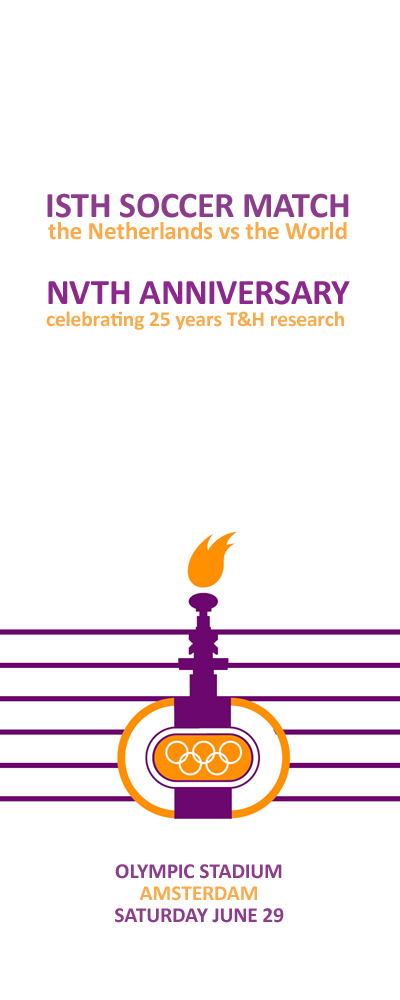
Dring the ISTH conference which will be held in Amsterdam this summer we will be organising the traditional ISTH Soccer Match (hostland vs the world) on saturday 29th of june in the Olympic Stadium Amsterdam. Before, during and after the soccer Match we will also celebrate the 25th birthday of the NVTH, the Dutch version of the ISTH. More information will follow, but for now I can present you the design of the entrance tickets. Woehoe!
 bob siegerink